

Reimagining risk: changing the calculation
The challenge
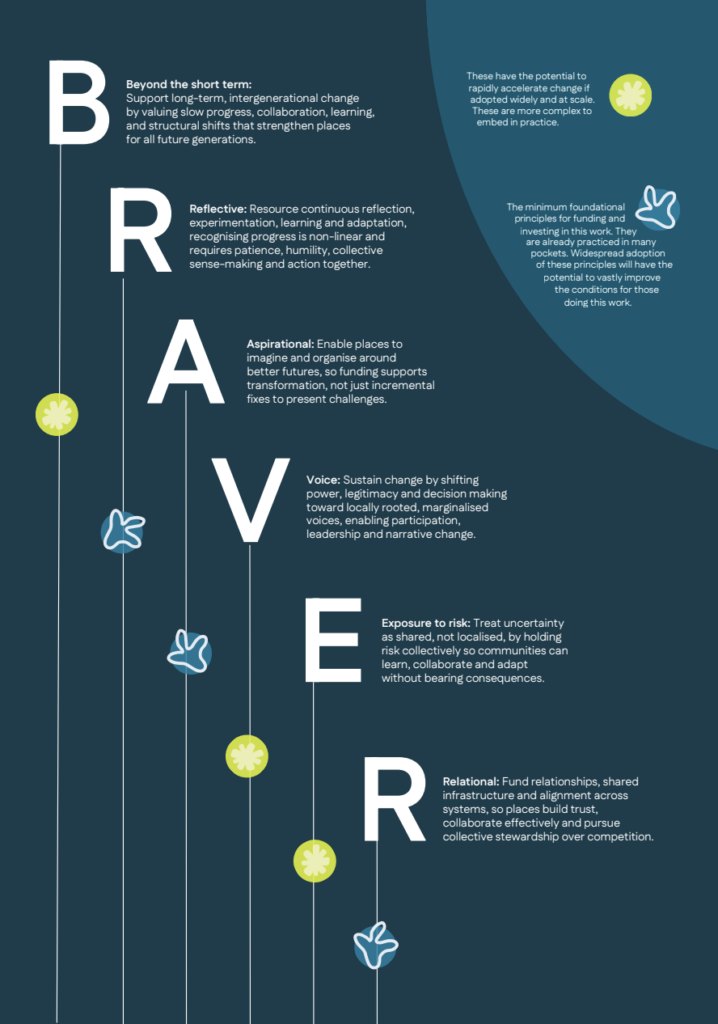
Our recent inquiry into how to sustain place-based systemic change yielded a set of principles for more sustainable funding practice: the BRAVER principles. Taken together, these principles set out key approaches that those funding and supporting place-based systemic change could take, with a view to supporting this work to embed and thrive beyond a short-term time horizon. I spent much of the summer in conversations about these principles, with colleagues across the sector, and in presentations at New Local’s Stronger Things conference and at London Funders Festival of Learning. I was heartened to hear how many people these principles resonated with. I was also interested by so many of my conversations circling back to one theme: the different types of risk present in place-based systems change, how they are held, and where (and with who) they sit in the system. As a result, it was a theme we wanted to explore further with our Place-Based Systems Change Community of Practice in our September meeting.
Exposure to risk
Our BRAVER principles point to a need for organisations interested in supporting place-based systems change to consider – and shift – how they approach exposure to risk. This includes acknowledging that uncertainty is inevitable in systems change, so funding and delivery plans designed around linearity can work against emerging change and can hold back the experimentation needed to transform local systems. The findings from our inquiry demonstrated that traditional funding agreements which have specific milestones, targets, and withdrawal clauses can push against the change they are trying to make – incentivising tick-boxing and restricting organisations’ ability to pivot in response to emergence and learning.
In our BRAVER principles, we call for risk to be treated as shared, not localised, and for more time and attention to be committed to understanding systemic risk. A more collective approach to risk holding would allow whole systems – from funders to community members – to learn, collaborate and adapt, coming together to mitigate in real-time the risks in front of them. It was powerful to come together as a Community of Practice to explore what this means in greater depth, and to hear practitioners in our community share how this manifests for them.
The types of risk we explored
The Community of Practice surfaced a wide range of types of risk, bringing nuance to the types of risk that are traditionally considered when developing and funding this work. These are held in many ways and in different parts of the system, and often in multiple parts of the system at once. Here, when I talk about the system, I am thinking of everyone involved in change within place – this might span community members, community organisations, local government, funders, investors, anchor organisations, and more. The list of risks below is not an exhaustive one, and it is one we’d love to add to over time. Some of the risks our Community of Practice members had experienced and witnessed included:
| Type of risk | How it might manifest |
| Social and relational risk | During our inquiry, social risk was described by Mark Pepper at Ambition Lawrence Weston as the risk community leaders or local organisations may take to their own relationships and social experiences when engaging their own community in an initiative which may have positive and negative impacts on that community.
This connects to the relational risks taken when leveraging relationships to progress an initiative. Here there are risks to the relationships themselves, and risks when core relationships are lost due to personnel change. |
| Reputational | The risk of an initiative causing damage to your personal or organisational reputation. This can connect deeply to social risk and relational risk, especially at a community level, and can connect deeply to financial risk at a funder or investor level. |
| Financial | The risks associated with the funding of, and investment in, any place-based initiative. Risks vary here depending on the funding or financing model, the nature of place-based working, and how the money is held, managed and/or distributed. It is traditionally associated with the risk faced by those investing the money, but financial risk is also held by those absorbing the finance. For example, those absorbing finance hold financial risk where they are funded or commissioned to deliver work that may have higher costs than their allocated budgets, or risk around sustaining income generation in a repayable finance model. |
| Timeframe | The risk taken when navigating the trade-offs that so often come with programme timeframes. An example shared by our Community of Practice included managing the risks of ensuring delivery happens where a timeline is fixed, but balancing this with the risk of less meaningful and impactful delivery if timeframes aren’t long enough to allow for meaningful co-production. |
| Wellbeing | The risk taken when driving an initiative forward has a negative impact on the wellbeing of those driving it. Where responsibility for an initiative falls on a few individuals this can drive worry and fear, disengagement and at worst, burnout. It can also discourage experimentation, adaptation and risk-taking. It may be commonly felt by those holding risk most in isolation – either individually or organisationally. |
How risk is currently held in the system
Thinking about the system as set out above, each of these actors is often holding different types of risk, and often these risks are identified, managed and mitigated in siloes. This leads me to two points for further exploration around the amplification of risk. The first is the extent to which holding some of the risks identified above in a silo can actually amplify the risks themselves and create additional categories of risk. The second is whether siloed risk-holding may also have a cumulative effect on wider systems change work over time: would committing to more emergent and long-term work feel easier for everyone in the system if the risks were surfaced together and held together?
One practitioner pointed out that for risk to be shared, funders and commissioners would need to meaningfully account for the social risk held by community leaders and the financial risk and organisational precarity often held by VCSE organisations. The Community of Practice reflected that reckoning with how this risk can be held collectively could minimise some significant risks: the risks of burnout from holding a huge amount of risk, the risk to relationships both within communities and between communities and funders when initiatives end, and the threat of closure of key community institutions when too much risk is absorbed. require VCSE organisations and community members to stop holding their own risk in siloes, beginning to openly surface the risks they are facing to partners in order to explore ways to hold and mitigate it more collectively.
Overall, there was a recognition of the need to better surface the social, financial and organisational risks held by community members, community groups, and VCSE organisations in these initiatives. There was also a real energy to explore how risk might be held more collectively. This is something Dark Matter Labs have explored through their impressive many-to-many portfolio – exploring risk through the lens of a balance in governance. Dark Matter Labs point to instances where there are imbalances – where those who have the least power and accountability to shape something bear the most responsibility for how it manifests.
Reimagining risk
There is a huge amount to be done here. To close our session, our Principal Consultant Kezia del Carmen led us through an imagination exercise. Join in for a moment, if you can:
In your mind, go back in time ten years. What were you doing? What were you worried about? What risks were you holding in your work?
Come to the present. How have those things changed over time?
Now go ten years into the future. Imagine that the challenges we’ve explored here have all been solved. Imagine we have healthy, collective and just ways of holding, misk. How did we get here? What changes did we make?
What next?
What was clear from our Community of Practice meeting is that while place continues to occupy a critical role in how the sector approaches social change, we haven’t yet mainstreamed approaches to managing risk that surface the many ways it can manifest in place-base change or fairly distribute it, nor have we mainstreamed the mechanisms to hold it collectively.
There’s so much more we can do to mainstream different approaches to thinking about risk. The Community of Practice shared that they would love to see:
- Case studies and examples of more collective and long-term approaches to risk holding and management in work aimed at place-based and/or systems change
- Alternative approaches to managing financial risk that allow this to be held more collectively – including approaches to funding agreements, conditions and outcomes frameworks that support adaptive, relational and complex work
What we plan to do
If you have any examples of this, we’d love to hear them and amplify them. We’re also building up a group of practitioners, funders, investors, local authority officers and others interested in mainstreaming some alternative models of surfacing and collectively holding different types of risk. Interested in being part of the conversation? Contact beth@renaisi-innovation.com